AristotleA fencing psychology project
A short, reflective questionnaire about what fencers think about while they fence: before the bout, between touches, in the middle of an exchange, and as the score changes.
What is the Aristotle Fencing Psychology Project?
Fencing is often referred to as physical chess because a fencer needs to out-think their opponent in order to win. This is a well-established idea in the fencing world, but there is not a clear idea of how to think or what to be thinking about during a bout.
The Aristotle Fencing Psychology Project seeks to better understand what different fencers think about during their bouts, and then to learn how different ways of thinking result in victories or defeats.
This project has several goals.
- Using this data we hope to correlate different ways of thinking with how well a fencer performs.
- By asking these questions to participating fencers, we hope that they will pay more attention to their thought processes during their bouts and seek to discover for themselves what will lead to success.
- Finally, after taking the questionnaire, participating fencers can register with this website and see the different answers to the questionnaire from other fencers. There will be a forum to comment and discuss, all with the goal of increasing the overall understanding of this very profound topic.
What to Expect
What follows is a questionnaire that explores a fencer's thought processes while they are fencing. It does this for a variety of different fencing situations, all with a goal to understand what goes through a fencer's mind during the different moments of a fencing bout. And with better understanding comes wisdom, and through wisdom comes victory.
- questions covering different aspects of a fencer's thoughts during a fencing bout.
- Every question is optional; leave blank anything you don't want to answer.
- You can review and change any answer before you submit.
- Some of the questions might be perceived as ambiguous. Feel free to make any assumptions that you like when answering.
- We won't ask for your name or email address to take the questionnaire, but if you want to review the answers from other participating fencers, you'll need to open an account and provide an email address.
- There are no wrong answers. No one knows better than you how you think.
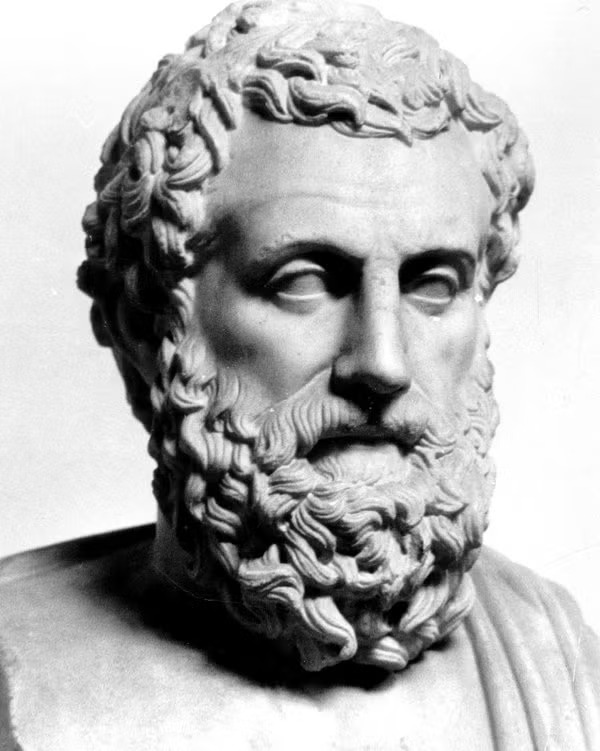
Who was Aristotle?
Born in 384 BC in northern Greece, Aristotle came to Athens to study under Plato at the Academy. He later tutored the young Alexander the Great before returning to Athens to found his own school, the Lyceum. Aristotle's genius was broad and deep: he wrote foundational works on logic, physics, biology, ethics, politics, rhetoric, and the nature of the soul, and in nearly every field he touched, his questions and distinctions shaped the subject for two thousand years after him.
Central to his ethical writings is the concept of phronesis — practical wisdom — the capacity of an experienced person to perceive, in the immediacy of a particular situation, the right thing to do without pausing to reason it out from first principles. For Aristotle, this kind of judgment wasn't instinct in the crude sense; it was intelligence, refined through repeated practice, that had come to act instantly and correctly.
It is this topic of Aristotle's work that makes him the inspiration for this project; an inquiry into how thoughts become decisive actions.
Ready to Reflect?
Think back to your last few bouts, and tell us what was going through your mind.